|
Below is the account of an orthodox, Bible-believing seminary student who attended the ELCA's United Lutheran Seminary. We conversed over email at couple years ago and then again last week. What follows is Joseph's letter to me and to everyone reading, about his experience attending the Evangelical Lutheran Church in America seminary.
Dan, At the time of our correspondence, I was unsure of what direction my vocation was going to take so I did not want to divulge too much information about what I was encountering at seminary, for fear of retaliation from the so-called “powers that be.“ I use quotations because the people who are in charge of the ELCA are not actually the ones who are running the show. But I’ll get to that in a moment. The reason why I am writing today is because I feel that my personal story and experience might be of some benefit to your readers. First and foremost, I must be transparent in stating that I have since left seminary and Lutheranism altogether and returned to the Catholic Church of my roots. Recognizing that there are many Lutherans of a more traditional practice who might be skeptical of Roman Catholic theology, I want to emphasize the fact that we have far more in common with one another than those same traditional Lutherans might have with ELCA Lutherans, and the proof is in the proverbial pudding. Putting all theological differences and minutiae aside, I think I can say with certainty that traditional Lutherans and traditional Catholics are at least mutually faithful to the basic tenets of Christ’s teachings. With that said, I would like to share a little bit of what I experienced—and what I still observe from social media posts and the ongoing firsthand accounts of friends who are ELCA clergy—friends who I cherish. They are not the intended target of this expose. It has been said, ad nauseam I might add, that the ELCA is the “whitest denomination in America.” This is a common phrase uttered by some of the loudest, most bloviating “pastors” in the ELCA. Statistically speaking this may very well be the case. But what I find most interesting about that is the fact that the individuals who are so quick to utter this phrase are the same individuals who initiate every attempt at dialogue with the preemptive notion that if you’re white, you have an obligation to “listen” and not speak and this is actually done as a means of shutting down the dialogue before it can even begin. So if the denomination is 99%+ white, what they’re saying is that only they, the small 1%—many of whom are also white, interestingly enough— should be allowed to speak. This is neither dialogue nor an attempt at equality; it is a hostage situation. And in no venue was this made clearer than in the seminary classroom. I had a professor of New Testament studies who started the semester right out of the gate by informing the class that if you were a white, straight, “cisgender” male, you had an obligation to stay quiet and allow other people to speak before you. Understandably this put a number of us in the position of feeling like we were paying for classes that we were being discouraged from participating in. So I took the professor’s advice and decided not to say a word in class. As the semester went on, that professor started to become passive-aggressively antagonistic toward me by calling on me at random times to contribute—usually when she knew that my opinion on the topic du jour would likely lead me to say something that the “wokesters” in the class would pounce on. I chose not to give her what she was looking for, as there is no winning on their idealistic playing field, and of course she decided to dock participation points from my grade. This same professor--and others--would dock points if you referenced God as "Father." When I explained that God as my Father was the only way I knew how to encounter Him, I was told "it's not all about you." At that time, I was still writing for a Catholic blog and I wrote a critique that was aimed at dispelling all of the nonsensical, heretical revisionist history being spewed out in her class. The fact that I wrote for this website was not, to my knowledge, known to my classmates at the time. Little did I know that the “Google sleuths” were hard at work trying to dig up material to use against me. And they succeeded, though I must say that I was not exactly hiding anything as it was all public information in plain sight. This led to almost weekly summonses to the Dean’s office where my guidance counselor and this same professor would be waiting to interrogate me and threats would be made to “call my candidacy committee.” In other words, my orthodoxy was being used against me. During one rather bizarre exchange, I was leaving class one afternoon and was blindsided by a seminarian who proceeded to scream at the top of her lungs, crying maniacally with snot bubbles and an Oscar-worthy act, calling me a racist, a sexist, a transphobe, an imperialist, a supremacist and every other “-ist” imaginable because she had come across an article I had written in defense of Western Civilization--I was, after all, a history major during undergrad. This was in a crowded hallway in front of my peers. This was supposed to be graduate school. I was repeatedly threatened by other professors, many of whom I genuinely believe felt pressured to enforce and live up to the standards set by the loudest and most unhinged seminarians and pastors, that they were going to contact my candidacy committee about things that I wrote in assignments or said in class. I was told on a number of occasions that fellow seminarians did not “feel safe“ being in the same building as me because I identified as pro-life. I was told that I was anti-woman and unchristian for opposing abortion on the unthinkable grounds that all human life is sacred. A self-described “abortion doula” said that she did not feel her kids were safe around me because I was a homophobe and micro-aggressive mansplainer. When it was learned that I had attended Latin Mass in my early 20's at the private chapel of Mel Gibson, I was branded a white supremacist and an anti-Semite. When that young high school student, Nick Sandmann, stood on the steps of the Lincoln Memorial during the March for Life while an activist banged a drum in his face, I applauded him in class for maintaining a dignified composure. I was branded a “colonizer” and anti-Native American for that. In my Congregational Education (I think that was the title) course, I gave a presentation in class on Martin Luther‘s devotion to Mary, the Mother of God, and I was told that I was trying to infuse patriarchal Catholicism into the seminary environment. I’m not really sure how that conclusion was reached based on the presentation I gave but then again logic and reason were probably considered “white supremacist“ on campus. Simply using the word “civility“ was considered racist. If that does not exemplify the soft bigotry of low expectations, I don’t know what does. And I suppose the part that amuses me the most is the fact that throughout this entire fiasco, my mentor and closest advisor on campus was a black Baptist professor—who I am still close with today—who was, at every stage of the game, flabbergasted by the charges lobbed against me. Of course the “wokesters” would call me racist for mentioning that, because in their world everything that they say is racist is de facto racist but this brings me back to my main point which is that the hierarchy of the ELCA, flawed as they may be theologically, is being held hostage. They no longer have any power because the small minority of individuals who openly brag about the fact that they are looking to dismantle everything, including orthodox theology, controls the narrative. If the presiding Bishop or other bishops say anything that the “wokesters” disagree with, they are swarmed upon and branded every negative thing under the sun. If those same bishops say nothing on an issue, they are charged with being complicit in bureaucratic and systemic white supremacy. So either way, the well-meaning bishops lose and the “wokesters” win at their own rigged game. By appealing to the court of secular public opinion, this small minority of heretical activist "pastors" are actively destroying the church from within and with great success. During my time as a vicar at a rather conservative Long Island parish, I was repeatedly told that the needs of my parishioners, many of them law enforcement officers and firefighters, didn’t matter because they were part of the “systemic white oppressiveness” that the “wokesters” were trying to dismantle. It was my obligation, they would say, to “challenge” them and oppose their “racism.” I never saw any racism at this parish. I simply saw people who loved God and loved their neighbors. This was a parish that routinely filled the church for all three Sunday services—unlike the first parish I was initially assigned to in Philadelphia where we averaged around 11 people for the one service they held every Sunday, but hey, at least they were “woke” and “relevant.” I lasted for three weeks at that parish until a parishioner said he would no longer attend the parish if I was there because he saw something I wrote on social media about the possible connection between mental illness and gender dysphoria. No conversation took place about it, I was simply told that I needed to find a new placement because this individual “didn’t feel safe” around me. I never realized what a menacing, imposing individual I was. Nevertheless, the fact that the parish that is attracting hundreds of people every Sunday with their orthodoxy is viewed as a threat to these individuals—and the fact that this same parish has to largely insulate itself from the rest of the ELCA for fear of retaliation—is all you need to know about who is running the show. Students who lean conservative or are at least moderate tend to stay silent and keep their heads down, which is shameful because these individuals are paying for the same education as everyone else and deserve to be able to participate in their own pastoral formation just like everyone else. The fact that they have to be afraid that anything they say which might be perceived as "offensive" (which in almost every case means they're upholding orthodox Christian teaching) is a disgrace. I know that the "woke" individuals read your blog, Dan, because it serves as conversational fodder fairly often on campus so I'm sure if any of my former classmates or their crony gurus read this, they'll have all kinds of snarky responses and defenses for their actions. They'll say I'm bitter and jaded and racist and all kinds of other things, but the fact is that they engage in deflection at every turn because they know exactly what they're doing. They are actively destroying the ELCA from within and they don't even try to hide it. These narcissistic activists are perfectly fine with seeing 3 million baptized Lutherans without a church in order to push their narrow-minded, heretical agenda of fabricating a Church of Christ without Christ, to reference Flannery O'Connor. They look to burn it all down yet they offer nothing of substance to replace it with, other than idealistic pipe dreams of egalitarian utopianism and yet, in reality, what they're really trying to do is seize power in order to become the oppressors that they seem to see in everyone else. They don't want equality; they simply want to control the narrative. I could go on and on but these are some of the highlights from my year at ULS. Best Wishes, Joseph M. Di Marius
4 Comments
"The Reconciling in Christ (RIC) Program is for congregations, synods, colleges, seminaries, and other Lutheran organizations. Lutheran communities that publicly welcome lesbian, gay, bisexual, and transgender (LGBT) people by having a statement affirming this welcome by specifically saying either, 'LGBT' or 'people of all sexual orientations and gender identities' in their statement, are accepted onto the Reconciling in Christ list..." (See here) He and many others want to force ELCA churches to declare LGBT lifestyles and sexual relations "good." That is what "welcome" means in the ELCA and RIC. Additionally, the pastoral student posted these tweets calling a video which views homosexuality from the Biblical perspective as "anti LGBT" and trying to put pressure on Youtube and Google for letting them post a video about their beliefs.
If you click on the "Oct. 14, 2018" link on the tweet you will see all the additional news outlets Andrew tweeted about this. ELCA Leader Says It Is the 'Deepest, Darkest Dreams of So Many' ELCA Members To Kill Black People12/10/2016 If you are an ELCA member who voted for Donald Trump, are not marching with Black Lives Matter, are white, Bible-believing, conservative . . . YOU are the problem, at least in the view of liberal, wacko, Christian-in-name-only ELCA leaders. Here is a post made last week on the ELCA Facebook group by Francisco Herrera, a Ph. D student at the ELCA's LSTC who is also the "Diversity Blog Manager" at the school (see more information about him here): 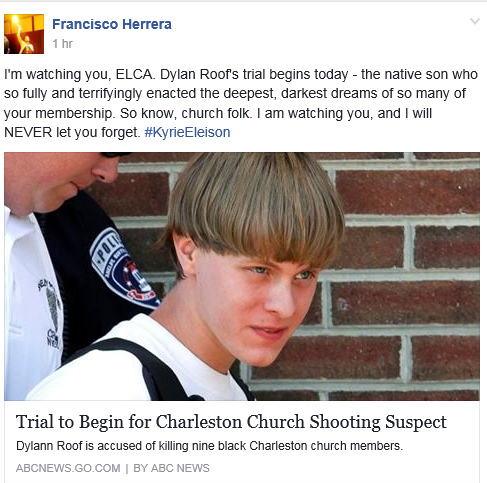 (Dylann Roof is an ELCA member who killed nine black people at a church in Charleston, South Carolina.) You may want to reread what Mr. Herrera said. He is stating that many ELCA members want to kill black people, that it is their "deepest, darkest dreams" to do what Dylann Roof did. This is a leader in the ELCA. Did I mention that Mr. Herrera is the Operations and Fundraising Coordinator for #decolonizeLutheranism? This is a group which has gained a huge following within the ELCA leadership. Anger and hatred for Bible-believing ELCA members is growing strong. The ELCA leadership has done its best to force its liberal, Bible-defying measures upon them. They have even convinced some members that the ELCA is right in declaring homosexual sex "good," that Israel is an evil entity, abortion is "loving," transexuals are correcting God's mistakes, converting non-Christians should not be pursued and the Bible is full of myth and mistakes. But that isn't enough, now many ELCA leaders are telling ELCA members how racist they are, that their Lutheran cultural traditions are discriminatory and that they are the problem. If you do not assimilate to all of their view points, you are the enemy. And the election of Donald Trump has greatly elevated their anger toward ELCA members who do not hold to their political, social and religious views. (see more) Here is more of the discussion from Mr. Herrera's post on the ELCA FB page: 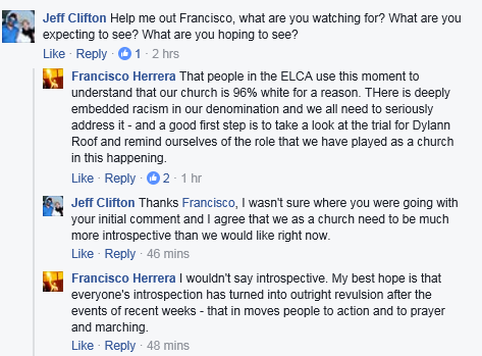 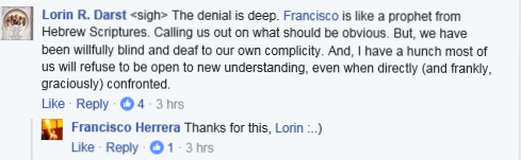 Why be a part of a denomination that treats you, and allows leadership to treat you with such contempt?
The United States has just experienced another Muslim terrorist attack at Ohio State University. The far left is in denial about the lethal call of Islam against non-followers of the religion. Muhammad, the founder of Islam, acted viciously against those who did not believe his new religion. Today, many followers of Islam act in the way of their founder and carry out what he has instructed, as written in the Quran.
In the Evangelical Lutheran Church in America, a large majority of the leaders and pastors are liberal in their thinking and their theology. They are wretchedly warped and in denial about Scripture that they cannot understand that Islam is a false religion: that its followers worship a false god and that millions of Muslims agree with the violent directives the Islamic god gives them in the Quran. The ELCA does not condemn Islamic ideology. They do not speak against or even confirm that it is a false religion. They deny Islam's responsibility for terrorist acts by followers of Islam. Instead, the ELCA stands with them seeing them as the victim, and views people as "Islamophobes" who warn and reject the violent teachings of this false religion. And the ELCA speaks out against imagined discrimination against Muslims. See below: 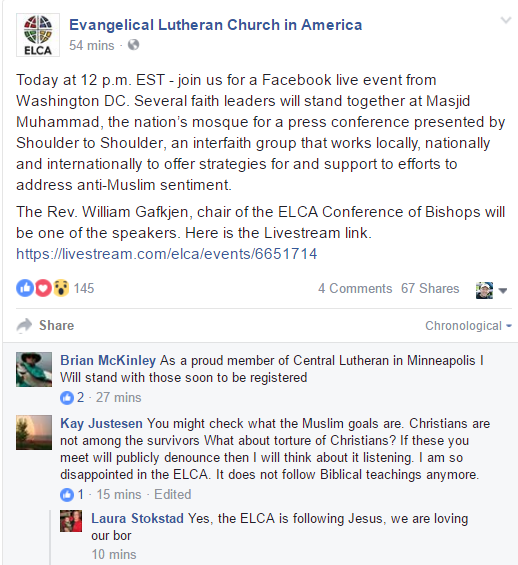
Then you have ELCA pastor Clint Schnekloth, author and blogger who facilitates the ELCA Clergy Facebook Group with over 5800 members, who last month was encouraging people to do this: 
Not to be left out, there is ELCA pastor Joshua Ehrler encouraging everyone to take their youth to a Muslim prayer service. He writes:
“If you are part of a Christian youth group, it would benefit your faith and your heart for humanity to schedule a visit with a local mosque…Learning different cultures and faith traditions upholds our own and destroys the false stereotypes that only separate us as God’s people. I hope you find a Friday night to attend a Muslim prayer service with your youth group. Make the call, and thank God for the opportunity.” (see here)
Mixing liberal politics with a poor understanding of Scripture and religion, ELCA pastor Katrina Foster writes:
Rev. Kathryn Lohre, ELCA Executive for Ecumenical and Inter-Religious Relations and the Past President of the National Council of Churches tweeting the video of the press conference shown above. The ELCA notes that the gathering was intended to "demonstrate interfaith cooperation and solidarity, and to call on the incoming administration to protect religious liberty and defend Muslims against violence, hate speech and discrimination." (see here)
God tells us: Do not be yoked together with unbelievers. For what do righteousness and wickedness have in common? Or what fellowship can light have with darkness? What harmony is there between Christ and Belial? Or what does a believer have in common with an unbeliever? What agreement is there between the temple of God and idols? For we are the temple of the living God. 2 Corinthians 6:14-16 Islam is not a religion of peace. The god of Islam is NOT the God of the Bible. Muslims are safer in America than anywhere else in the world, much safer than Christians and Jews are in Muslim countries BY FAR! Muslims are people who need to know the Lord Jesus as their Savior. Let us pray for, and not with Muslims. Let us look for opportunities to guide Muslims to know Jesus, not guide our youth to attend worship gatherings of a false god. Let us introduce others to the Prince of Peace, rather than deny the call toward terror of radical Muslims. Let us ask God to use us as we take a stand for Him in a world that desparately needs to know the One True God. Over the past year I have been come across a number of comments by ELCA pastors who are calling the 2009 ELCA policy on homosexual pastors “discrimination” for allowing congregations to refrain from calling or considering a practicing homosexual pastor for their position. The same ELCA leaders also view the congregation's decision to not consider a sexually active gay pastor to be discriminatory. Read the following comment/question to ELCA Bishop Bill Gohl by ELCA Pastor and moderator for the ELCA Clergy Facebook page, Clint Schnekloth:
“…the current policy established in 2009 would allow congregations from excluding candidates who are in committed, same-gender relationships. Are you saying that you won't allow congregations in your synod to exercise that form of discrimination, even though it is enshrined in our current polity? If so, I commend you, but I wonder, will you also work to change the discriminatory policies we adopted in 2009, and work for full parity for all rostered leaders?” (see comment section of the Bishop’s blog here) Another ELCA leader, Libby Howe, responded to Rev. Schnekloth saying: “Thank you for this question. As one responsible for the mobility process in my synod, I am troubled by the way that the 2009 decisions permit, in fact encourage, congregations to codify discrimination. Not only that but they also require pastors to disclose their sexual orientation to the synod office (who is bound to honor the discrimination of congregations) whether or not a pastor wants to.” And Pastor Jason Churchill said: “To name the exclusion of any candidate based on race, color, gender, or sexuality by the church is nothing less than to name it one of the greatest sins we have committed against the Creator.” So according to many ELCA leaders a church is “discriminating” against homosexuals if they do not want an unrepentant practicing homosexual as their pastor. I don’t see how anyone who believes Scripture, that homosexual activity is sinful, can feel welcome or safe in the Evangelical Lutheran Church in America. The following personal account and exchange comes from the comment section of this article about abortion and the church and took place in 2009.
One persons writes: “I am the wife side of Lutheran Lurker, or should I say ex Lutheran Lurker. My husband walked away from 22 years of parish ministry, into the darkness of a recession, over life issues. We were ELCA in a very liberal congregation. It was clear to us that any, and I mean any however subtle, hint of pro-life leanings was met with temper tantrums and aggressive action. I felt that my head was going to explode. I have bitten my tongue so often it is almost off. A few years ago, I purchased a Feminists for Life bumper sticker for my truck. I was afraid to put them on, knowing the consequences. That sticker sat in the drawer for two full years haunting, or perhaps better stated, convicting me. Eventually, it went on and Hell did break out. Anyone who tells you these mainline churches are tolerant is fooling themselves. They are militantly pro-choice with a handful of pro-life people afraid to come out of the closet on the issue because most of the other church choices involve the word Catholic or evangelical. He is still job hunting, any leads would be appreciated. We crossed the Tiber where the air is cleaner and the grass is greener. As a wise mother of a young man with developmental disabilities in our special service said, “no regrets, except for the timing.”” Someone replies: “Lutheran Lurker, my heart goes out to you and your husband for making this difficult and courageous stand. In the 80s, I was a member of an LCA church that then became an ELCA church. When I asked my pastor for a reference because I was applying to become a volunteer at a crisis pregnancy center, he got very angry and told me off. He then went into a long tirade about the importance of allowing abortion in all kinds of situations, giving half a dozen or more examples from his years counseling parishioners who chose abortion with his blessing. He initially refused to give the reference, saying crisis pregnancy centers were very harmful organizations who hurt women badly. He then reluctantly gave it. Learning his response, I didn’t have the courage to bring up the abortion issue with anyone else in the congregation. And it wasn’t long before I moved on to another church. Your experience is so very sad. I hope your husband is able to find a job soon. This reminds me of the story of Richard John Neuhaus, the Lutheran pastor who was a liberal civil rights activist changed forever by Roe v. Wade, and who left the Lutherans to become a Catholic. Most likely you know way more about him than I do.” (From Dean Kallenbach)
Friends, This note was forwarded yesterday to members of her congregation by Grace Lutheran-Eau Claire president Anne Carter. Please continue to keep Grace and its pastors in your prayers.... Dean NEW DEVELOPMENT UPDATE March 22, 2013 This afternoon both Pastor Nestingen and Pastor Irgens were informed by letter that they have been removed from the ELCA roster of clergy. Their removal is effective March 22, 2013. Bishop Duane Pederson removed both pastors. He reasons that both pastors have engaged in schismatic activity by allowing Grace Lutheran Church to dually affiliate with the LCMC. He also claims that they have defied the Synod Council's decision and the civil courts. Bishop Pederson's actions do not meet the criteria for removal of pastors as outlined in the constitution of the NW Synod of Wisconsin. Grace has been dually affiliated for almost two years. Bishop Pederson has been presiding bishop during that time. This fall he announced that he would not seek re-election and instead will be leaving March 31 for a new position. No response has been determined at this time. 'But, dear friends, remember what the apostles of our Lord Jesus Christ foretold. They said to you, "In the last times there will be scoffers who will follow their own ungodly desires." These are the men who divide you, who follow mere natural instincts and do not have the Spirit. 'But you, dear friends, build yourselves up in your most holy faith and pray in the Holy Spirit. Keep yourselves in God's love as you wait for the mercy of our Lord Jesus Christ to bring you to eternal life.' Jude 17-21 Thank you for your continued prayers for Grace Lutheran Church. Anne I’d like to share some emails with you that I have received from some non-tolerant, vocal, angry ELCA supporters. Here are just a few direct quotes:
“Why not just go to seminary and pay the price for wearing the collar instead of this b******t? You really do not have the corner on the truth but somehow have grasped that you can stir the pot quite easily. Not a very Christian thing to do. Satan.” “You got to be kiddng. One assumes you represent no one. You are a fraud. No Christian would behave this wave. Your disgusting.” “Quit whining, and just leave the ELCA already. Those of us who remain members do so because we love our churches, believe the ELCA continues to follow the word of God and does so without preaching bitterness or anger (which you guys seem to love to do) and find comfort from it. Just leave, go start your own denomination and find some peace. Please.” “When did you become God and get to judge everyone else? This website is a joke and you should be very ashamed of yourselves....Just as God is of you! Jesus did not teach us to hate and judge others. Fear and intolerance is all that you are preaching. It is sad...and funny!” “Shades of Joe McCarthy! Again, have you no shame?” “God is neither male nor female, but has both masculine and feminine qualities. If God is man, then men are gods. The few instances of ELCA Female God are to recognize this. You are not exposing the ELCA. You are exposing your hate and ignorance.” I know many of you have also had this kind of anger directed at you. While it is never enjoyable to be verbally attacked, Christ warned us that this would happen. Jesus tells us in Matthew 5:11-12, “Blessed are you when people insult you, persecute you and falsely say all kinds of evil against you because of me. Rejoice and be glad, because great is your reward in heaven, for in the same way they persecuted the prophets who were before you.” As far as these comments go, I will just say that God has called me to this ministry of sharing and exposing what the Evangelical Lutheran Church in America teaches, believes and promotes. The Bible tells us, “Have nothing to do with the fruitless deeds of darkness, but rather expose them.” (Ephesians 5:11) It is out of love for God and love and concern for others that I, and many of you, speak out in the face of anger and ridicule. The following is a letter from both the council president and senior pastor of St. Mark's Lutheran Church in Marion, Iowa. (elca.org lists St. Mark's average attendance at 961) -------------------------------------------- March 27, 2012 There is on body and one Spirit, just as you were called to one hope when you were called; one Lord, one faith, one baptism; one God and Father of all, who is over all and through all and in all. Ephesians 4:4-6 Dear Partners of St. Mark’s, As we continue our Lenten journey, we give thanks to God for calling us to the cross and into a deeper relationship with Christ, and for continuing opportunities for faithful service to Him. St. Mark’s church council last updated you in late November regarding denominational issues. That update followed the council’s resolution to dual roster with Lutheran Congregations in Mission for Christ (LCMC) and the Evangelical Lutheran Church in America (ELCA). Since then, we have continued conversations with our synod bishop, Michael Burk, in regard to our relationship with the ELCA. In response to the council’s November resolution, Bishop Burk has placed St. Mark’s under censure and admonishment. Our council has continued conversations with the synod to fully understand what this means. The first indication of any change in procedures was that the synod office would not provide assistance to us in the pastoral call process. Our call committee, however, is continuing its work and has several excellent ELCA pastoral candidates with whom it is moving forward in conversations that may ultimately lead to a call. Each of the candidates is aware of our circumstances and is pleased to continue the interview process. This past week we received word that Pastor Perry Fruhling has been removed from the ELCA clergy roster. While the ELCA actions are disappointing, we anticipated that there could be some ramifications to our council resolution. Pastor Perry was called and will continue to serve St. Mark’s congregation for years to come. Arrangements have been made to ensure continuity of his healthcare benefits and pension. Since Pastor Perry was called according to our constitution as an ELCA pastor, we have simply extended the provisions of that call going forward. What follows remains in the hands of our local bishop and the Southeastern Iowa Synod Council. In our communication with the bishop, we have made it clear that we desire to continue our current relationship with the ELCA as a dual-rostered church. We continue as a congregation to generously support numerous faithful ELCA ministries. Our application to affiliate with the LCMC has been accepted, and we remain committed to being part of a Lutheran church body. Regardless of any ELCA actions, St. Mark’s continues as a Lutheran church and ownership of our building remains firmly with our congregation. Our building addition gives St. Mark’s the unique ability to reach out to the community and continue to serve others. Our recent Christmas Eve services and Ash Wednesday service had record numbers of people attending. As a congregation of faithful servants to God’s Word, we will continue to grow. We encourage you to pray for the ELCA, the LCMC and for all members of St. Mark’s as we move forward in serving Christ. As always, please call or email council@faith-life.org with any questions or concerns. Yours in Christ,
"Judge not, that ye be not judged." I imagine this verse has been said in nearly every ELCA church forum on homosexuality. But what does this verse really mean?
Below are two "Daily Devotions with Greg Laurie" Discerning, Not Condemning “Instead, we will speak the truth in love, growing in every way more and more like Christ, who is the head of his body, the church.” — Ephesians 4:15 It seems as though every nonbeliever knows Matthew 7:1: "Do not judge others, and you will not be judged." Generally, it goes something like this: The Christian approaches a compromising Christian or a nonbeliever and talks about his or her need for Christ. At some point, the Christian will say that a certain thing is a sin. The other person will respond, "Who are you to judge me? Doesn't the Bible itself say, 'Judge not, lest you be judged'? " So what does this verse mean? Is Jesus suggesting that we are never to speak truthfully to someone, even if what he or she is doing is wrong? Is that indeed judgmental? Does this mean that Christians are never to be critical or make an evaluation? What did Jesus mean when He said, "Judge not, that you be not judged"? Some people believe that to be a real Christian, you must love and accept everyone. You must be tolerant of everything and never register an opinion. But is that what a Christian is? No, it isn't. That assumption actually contradicts what we read in other passages of the Bible. People often say that Jesus was a great humanitarian, loving and caring and sharing. He was those things, but Jesus also was a revolutionary. Jesus confronted people. He had some choice words for the Pharisees, calling them vipers and hypocrites and dead men walking. When confrontation was necessary, Jesus would speak the truth to a person. We must do the same, but we need to do so lovingly. As Ephesians 4:15 says, "Instead, we will speak the truth in love, growing in every way more and more like Christ, who is the head of his body, the church." That is what we do with those we love. We should be discerning, but not condemning. (see here) Is It Ever Okay to Judge? Do you not know that the saints will judge the world? And if the world will be judged by you, are you unworthy to judge the smallest matters? — 1 Corinthians 6:2 Is there a place for judging? Are we to judge one another, and if so, on what basis? Jesus said, "Judge not, that you be not judged. For with what judgment you judge, you will be judged; and with the measure you use, it will be measured back to you" (Matthew 7:1–2). The Greek word Jesus used for "judge" means, "to separate, choose, select, or determine." In context, we see that Jesus is dealing primarily with motives. You cannot judge my motives, nor can I judge yours. We may have an evaluation of someone, but we can't see his or her heart. The better translation of this statement would be, "Condemn not, that you be not condemned." I am to make judgments and evaluations, but I am not to condemn. Some people are hypercritical. They are just looking for people to slip up. They are quick to jump to conclusions. As one of my favorite preachers, the late J. Vernon McGee, said, "The only exercise some Christians get is jumping to conclusions and running down others." Sometimes we are quick to jump to conclusions and quick to believe the worst instead of the best about someone. Jesus is saying we should not do that. So if someone says to you, "Well, doesn't the Bible say, 'Judge not, that you be not judged'?" your response should be, "Yes, but I don't think you understand the meaning of that statement." The reality is that Christians are to make judgments. A judgment is an evaluation, and we make them every day. We are not in a position to see a person's heart, and we are not in a position to bring final judgment on someone. Our objective is to never to condemn and put down; it is to help and restore. (see here) (Todays "Exposed Blog" is written by a pastor from Michigan.)
An ELCA news release today highlights the August 30th "Public Statement on the Islamic Center Proposal" by Bishop Robert Rimbo of the Metropolitan New York Synod. In his concluding comments, Bishop Rimbo states: "We commend ourselves to the reliable and merciful arms of the God of Abraham, the God whom Jesus calls Abba, the God whom Muslims and Christians in various parts of the world call Allah. THIS GOD (my capitals) promises a reign in which all shall be well." Am I understanding correctly that the learned bishop is referring here to God almighty revealed in the Word made flesh, Jesus Christ, as the God of many names, including Allah? Or perhaps, a public acknowledgment of many paths to God. It appears so, at least to me, since the bishop says THIS GOD PROMISES A REIGN...(all singular). Isn't this yet another example of the "big tent" ELCA which bends over backward to avoid or distort the biblical name of God for the sake of secular tolerance and "political correctness?" |
Prove all things; hold fast that which is good.
1 Thessalonians 5:21 Dan Skogen
Former ELCA seminary student and former ELCA member who is fed up with the ELCA's consistent mockery of God's Word. If you have been helped and blessed by Exposing the ELCA's ministry, please help us continue to proclaim the truth of God's Word to ELCA members who need to hear it.
Give online by clicking the "donate" button below: Categories
All
Archives
April 2024
 Exposing the ELCA is on Facebook 
Follow Exposing the ELCA on Twitter
Have nothing to do with the fruitless deeds of darkness, but rather expose them. - Ephesians 5:11
|
 RSS Feed