|
See the false blanket statement below made by the Evangelical Lutheran Church in America. The ELCA is deceiving people. Not everyone is a child of God. God tells us in His Word:
“To all who did receive him, to those who believed in his name, he gave the right to become children of God” (John 1:12). “By this it is evident who are the children of God, and who are the children of the devil: whoever does not practice righteousness is not of God, nor is the one who does not love his brother.” - 1 John 3:10 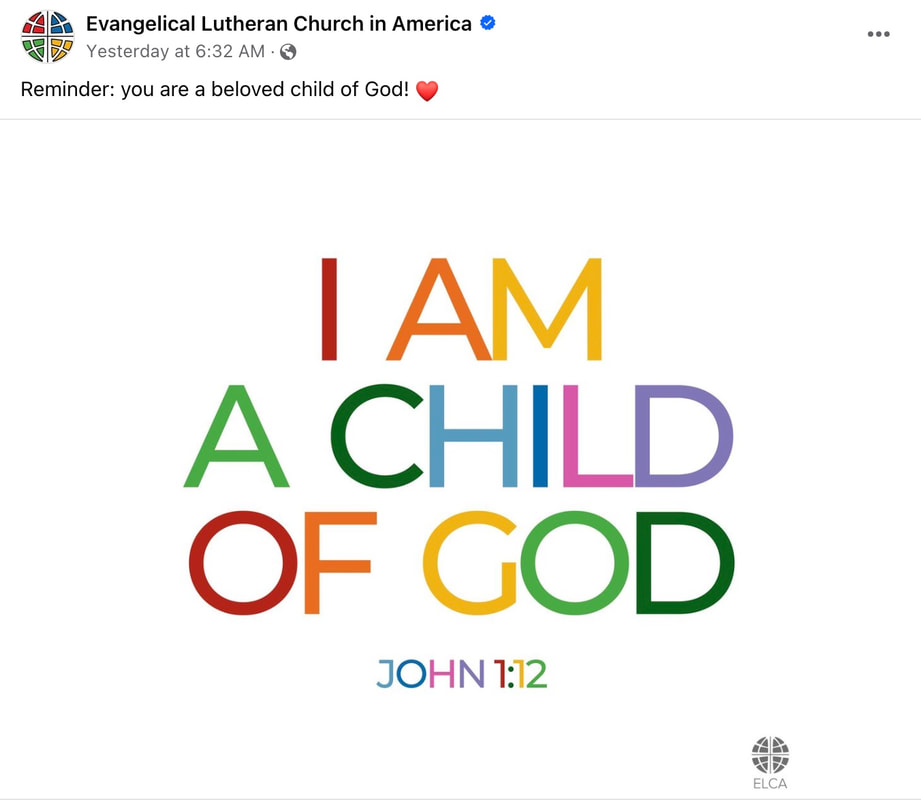
4 Comments
Former ELCA head bishop: Jesus was hurtful and mean to Syrophoenician woman, but He changed His mind8/21/2023 (The following article was written by Rev. Tom Brock of pastorsstudy.org. You can follow Pastor Brock on Facebook - here and Twitter - here.) I have reported before on Elk River Lutheran Church in Elk River, Minnesota, and their gay pride worship services. It makes sense that they have twice invited former presiding bishop of the Evangelical Lutheran Church in America, Mark Hanson, to speak since it was during his leadership in 2009 that the ELCA voted to perform gay weddings and ordain practicing homosexuals. In his sermon, Hanson defended “children who are transitioning” (to the opposite sex). Hanson then preached that Jesus was mean and hurtful in His response to the Syrophoenician woman. Gratefully, according to Hanson, Jesus changed His mind and showed mercy to the woman. Also, Hanson stated that the woman’s daughter was not really demon possessed in Matthew 15:21 but instead she had a mental illness. Hanson could have pointed out that Jesus was challenging and testing the Syrophoenician woman’s faith and then He rewarded her faith. Instead, Hanson stated that Jesus used despicable language to her. Hanson states that he was “flummoxed” by the way Jesus treated her (start about minute 35:24 below). But if Jesus sinned against this woman, then He would not be the innocent Lamb of God who takes away the sin of the world. If Jesus sinned, He would have to die for His own sins and could not die for ours. For this reason, the New Testament insists that Jesus was sinless (I Peter 1:18-19, 2:22, 2 Corinthians 5:21, Hebrews 4:15, I John 3:5). Sadly, this former head bishop of the ELCA did not insist on that point. In Christ, Pastor Tom Brock From the article The Church's Desperate Need For A New Reformation. By David R. Barnhart. From The Vine and Branches magazine. Vol. 38. Summer 2023, Issue 2. "At the time the Evangelical Lutheran Church in America (ELCA) was formed in 1988, the America Lutheran Church (ALC) had within its constitution an unalterable article of faith that affirmed the Bible as the 'inspired, infallible and inerrant Word of God.' It was this unalterable article that require the ALC be dissolved and an entirely new church be created, rather than have a traditional merger. The ELCA deliberately set aside this foundational, historical, and confessional article of faith regarding Scripture. The ELCA not only denies the inerrancy of Scripture, they forbid it from being taught in their colleges and seminaries. Today there is not a teacher in any ELCA college or seminary who affirms the Bible as "the inspired, infallible and inerrant Word of God."  What does the Evangelical Lutheran Church in America believe about the Bible? We can tell by what they say, by what they promote, by what they deny, by what they preach. (I document this throughout this website) This month the ELCA's magazine, Living Lutheran, published an article titled "The Story Behind the Story: Finding Greater Truths Behind Bible Tales". (Read here) As you read this article you will see the ELCA cast doubt on the Bible's account of historical events such as the Biblical six-day creation account, the miraculous parting the Red Sea, David fighting and killing Goliath, and Jesus walking on water. Here are some quotes from the ELCA article: - (Talking about the Biblical creation account and other culture's creation stories) "I can appreciate the beauty and poetry of these mythical details without taking them literally— and still worship the glorious Force that created the universe in ways I still don’t understand." - "Many ancient civilizations had flood stories similar to the Genesis story of Noah’s ark, but that doesn’t take away from the core message: God loves us and will not let us be extinguished. God’s word, God’s promise of protection, can be trusted. So in a profound way that story is true." - "Even the dramatic encounter between the little shepherd boy David and the giant Philistine Goliath may be misunderstood, says author Malcolm Gladwell. If it did actually occur..." - "Jesus turning water into wine and walking on the sea? Modern physicists hoping to prove or disprove the first story have written scholarly papers breaking down the chemical elements of both wine and H2O. Critics of the second posit that Jesus might have been treading on a thin sheet of ice. To me both miracles beautifully symbolize Jesus’ care for us, however they came to be." - "What Bible stories do you question? Which have strained credulity and even been stumbling blocks to belief? Why not let go of a desire to force these old, old stories into a rigid mold they may never have been meant to fit?" Pastor Tom Brock writes this about the ELCA article, "But in Living Lutheran magazine, a person’s subjective opinion about what may or may not have happened in the Bible trumps the Bible’s claim to historical accuracy." (See here) The Dean of Students and professor at an ELCA seminary told me personally that not one ELCA seminary professor believes Adam and Eve were real people. When the ELCA chose this article for publication, they validated it. This is a teaching that is embraced by the denomination. Denial of the Truth of God's Word is the root of the the problem, the source of evil, that has made the Evangelical Lutheran Church in America what it is today. It is a faux Christian church that embraces evil, that cast doubt on what God says, much like Satan did in Scripture. 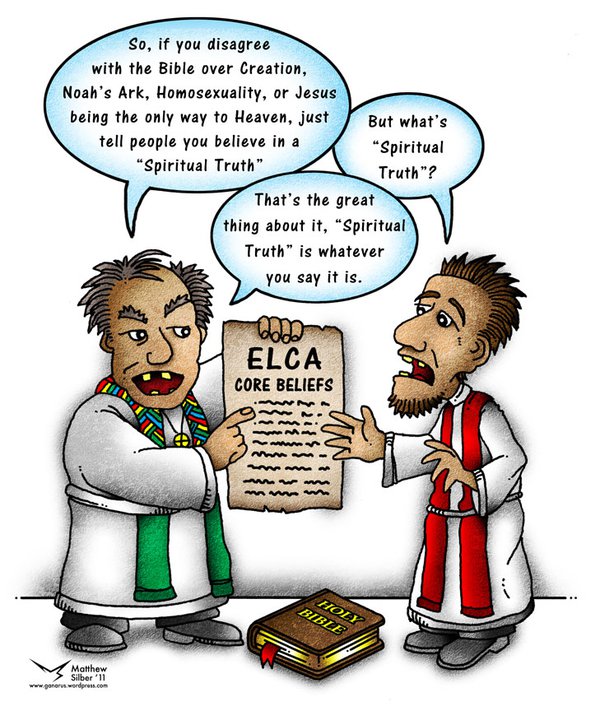 The Evangelical Lutheran Church in America made the following post on Facebook. 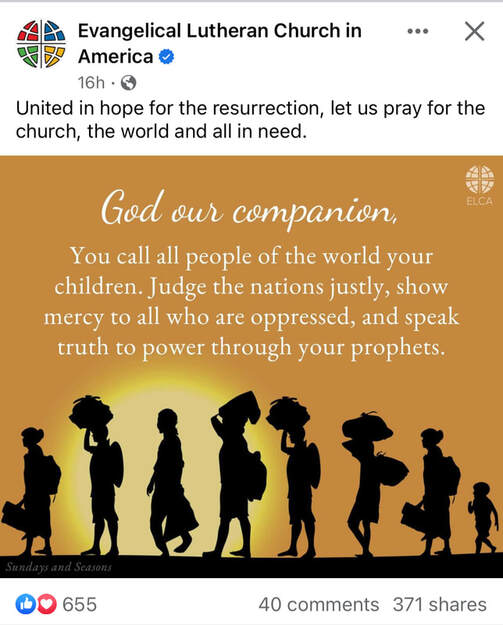 The ELCA has failed to correctly impart God's Word to people, as is documented on this website. Here is another example of the ELCA telling people something that goes against the truth explained in Scripture. The post, speaking to God, says "You call all people of the world your children." This is not what the Bible says. God's Word tells us in John 1:12, "But to all who did receive him, who believed in his name, the gave the right to become children of God". You can read similar statements like this in the Bible that have the same sentiment. (learn more about this here) Please stop listening to ELCA leaders, ELCA pastors, ELCA institutions, and ELCA publications. Know the Bible, do not just believe what you are told by others. Check them against what God's World says. This is true for all pastors, including those that are not ELCA but have been educated by the Evangelical Lutheran Church in America. (The following article was written by Rev. Tom Brock of pastorsstudy.org. You can follow Pastor Brock on Facebook - here and Twitter - here.) Lutherans believe in "Sola Scriptura", that the Bible alone is the highest authority for the Christian. Since the Holy Spirit inspired the Bible, and since the Holy Spirit and Jesus are one in the Trinity, Jesus and the Holy Spirit-inspired Bible are not going to contradict each other. But read the below in which the bishop of the Minneapolis Area Synod of the Evangelical Lutheran Church in America approvingly quotes the belief that Jesus and the Bible can contradict each other. "We Lutherans believe that the Bible truly matters. But, it doesn’t matter as much as the Word made Flesh. It doesn’t matter as much as Jesus. To quote Marcus Borg, “Jesus is the norm of the Bible. When the Bible and what we see in Jesus conflict, as they sometimes do, Jesus trumps the Bible. … In Jesus, Christians see more clearly than anywhere else the character and passion of God.” Years ago my Minneapolis bishop was Herbert Chilstrom who went on to become the first national bishop of the ELCA. He did not want anyone teaching in our Lutheran seminaries who believed in the infallibility of Scripture. Today, years later, this is the result: Lutheran bishops, pastors, and seminary professors who believe Jesus and the Bible can contradict each other. In Christ, Pastor Tom Brock (Read article from ELCA bishop here) 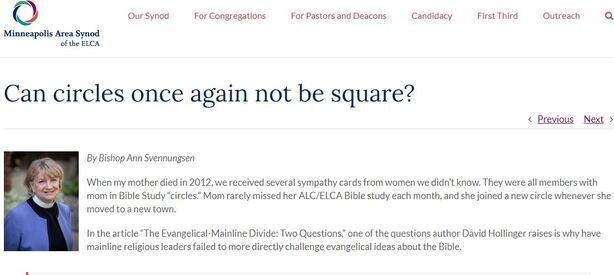 "Goodness and Mercy can be the names of God's righteous lesbian angels, mercilessly (and consensually) flirting with you your whole life. If you like that sort of thing. Ruthless and sacred pursuit from lesbian angels." A pastor in synod leadership in the ELCA, Lura Groen, wrote that on her Facebook page. (see below) Anything seems to go in the ELCA, from polyamory, to goddess worship, to sexual thoughts about angels and so much more. The ELCA, Evangelical Lutheran Church in America, is a denomination that has twisted the Bible for years. Satan is the biggest perpetrator of twisting the words of God and it looks like Satan is active and in many ways controlling this denomination. 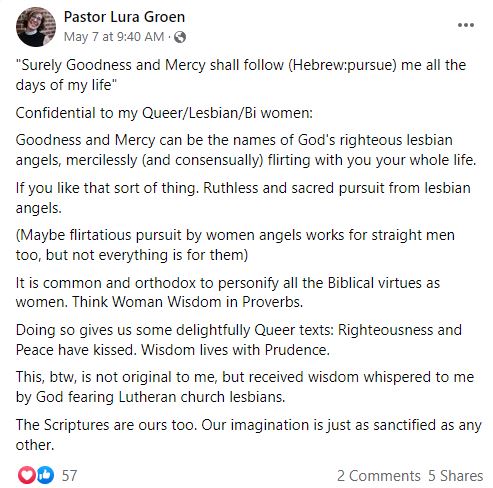
A bishop in the ELCA is teaching that the three faithful Jewish followers of God; Shadrach, Meshach, and Abednego, whom we read about in Scripture (Daniel 3), were transgender slaves.
The Evangelical Lutheran Church in America bishop Megan Rohrer, is transgender. And in a Facebook post last weekend, she shared her youtube video of her retelling this story. The video is titled "Transgender slaves Shadrach, Meshach, and Abednego Follow God When Fancy People Do Not." (See here) In one part of the Bishop's retelling of the story the ELCA bishop talks about Shadrach, Meshach and Abednego eating different foods than the others in the King's court saying, "they were able to get away with it because their bodies continued to please the king and others in the court who liked to look at them and probably other stuff" How can any faithful follower of Jesus remain in a denomination whose leaders are twisting and teaching falsely God's Word? 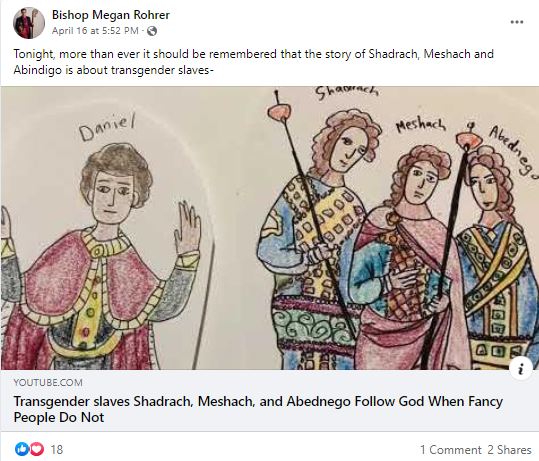
Trinity Lutheran Church in Chelmsford, MA is part of the Evangelical Lutheran Church in America (ELCA). Below is the prayer they used in their January 23, 2022 service. (I recently shared an article about a different ELCA church changing the words of the Lord's Prayer. See here) "THE LORD’S PRAYER Our creator in heaven, hallowed be your name, your kin-dom come, your will be done, on earth as in heaven. Give us today our daily bread. Forgive us our sins as we forgive those who sin against us. Save us from the time of trial and deliver us from evil. For the kin-dom, the power, and the glory are yours, now and forever. Amen." (See page 13 here) In Matthew 6 Jesus tells us "This, then, is how you should pray" and He then gives us what we now call the "Lord's Prayer." This ELCA church changed the words that Jesus gave us, replacing words "Father" with "creator" and "kingdom" with "kin-dom." Scripture tells us "Every word of God proves true; he is a shield to those who take refuge in him. Do not add to his words, lest he rebuke you and you be found a liar." - Proverbs 30:5-6. But we see this happen all the time in the ELCA. “How can some pastors be in favor of homosexual behavior when the Bible is so clearly against it?”9/30/2021
(The following article was written by Rev. Tom Brock of pastorsstudy.org. You can follow Pastor Brock on Facebook - here and Twitter - here.)
I have heard that question more than once and the below video shows an attempt by a congregation of the Evangelical Lutheran Church in America to make the Bible say what it doesn’t say. For 2000 years virtually all Christians have understood the Bible to be against homosexual behavior, but a new “woke” interpretation of Scripture has sprung up showing that all the Christians before us were in darkness and now we are enlightened. I don’t think so. I knew the pastor who served this congregation back in the 1990’s. He was a biblical, godly man. But today’s pastor below announces her preferred pronouns before sharing the new, “enlightened” interpretation of the Bible. This goes to show that a church can go from godly to awful in a matter of a few years if it has the wrong leadership. And this pastor— and the ELCA in general—is the wrong leadership. Sincerely in Christ, Pastor Tom Brock Twisting and rewriting God's Word is Satan's specialty. That is what comes to mind when we read the following Facebook post by ELCA pastor Clint Schnekloth. Rev. Schnekloth recently posted a transgender version of the Lord's Prayer. There is no God-honoring reason for you or your church to remain in the Evangelical Lutheran Church in America. 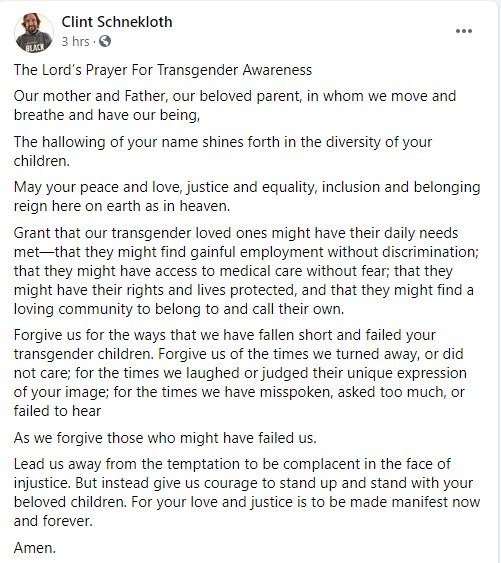 Every word of God proves true; he is a shield to those who take refuge in him. Do not add to his words, lest he rebuke you and you be found a liar. - Proverbs 30:5-6. Rev. Schnekloth has been frequently featured on Exposing the ELCA for his blasphemous, unBiblical and radical statements. (See here) --- Your support of Exposing the ELCA helps us continue our ministry. Gifts can be given by credit card, or PayPal at www.paypal.com/paypalme/exposingtheelca. If you'd like to give by check send me a message (here) for more information.
Ken Ham, founder and CEO of Creation in Genesis, the Creation Museum and the Ark Encounter, is a well known defender of God's Word and Christian speaker.
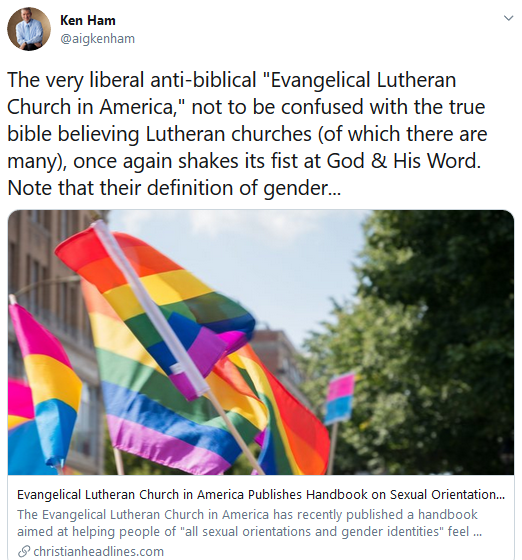
Ken Ham has spoken about the Evangelical Lutheran Church in America's departure from Biblical Truth in the past and this week he addressed it further on Facebook and Twitter when sharing an article titled "Evangelical Lutheran Church in America Distributes Handbook on Sexual Orientation, Gender Identity." 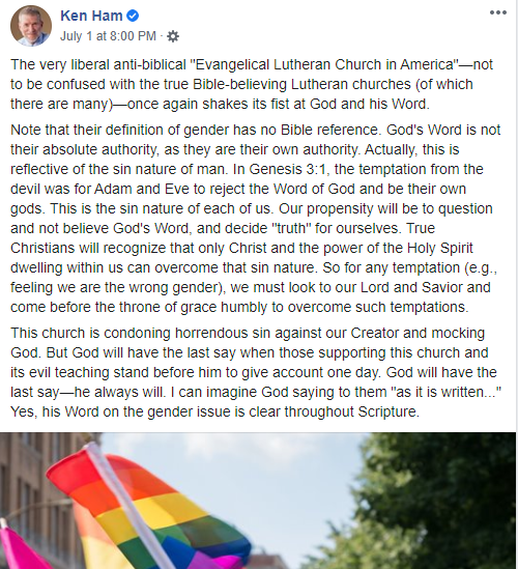
=================================== 
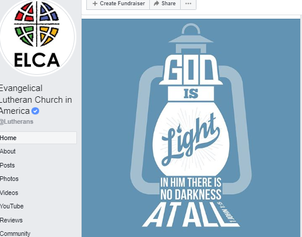
The first person to post a critical comment wrote, "Please consider the racial implications of what you are saying here. There is no darkness in him- really??? I assume exclusion (from God) is not your intent, but that is the impact. Please apologize and remove this post."
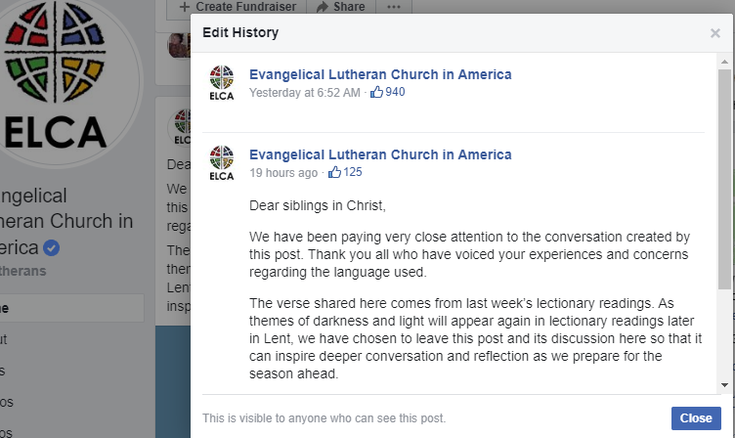
Another wrote, "Please don't ever again pretend to be confused about why we're 97% white. This post tells me so much about how my church is in relationship to my dark skin." A ELCA pastor also replied, "Just because it’s a bible verse does not mean it can’t be used to inflict harm on our siblings of color and perpetuate systemic racism in a church that is 98% white. The bible has been used to silence women, oppress LGBTQIA+ persons, and justify slavery. We need to choose our imagery carefully. We need to do better and not (unintentionally or not) alienate our fellow siblings in the body of Christ." And they went on blast mode from there, so much so that the ELCA had to edit their Bible verse image post with an addition: "Dear siblings in Christ, We have been paying very close attention to the conversation created by this post. Thank you all who have voiced your experiences and concerns regarding the language used. The verse shared here comes from last week’s lectionary readings. As themes of darkness and light will appear again in lectionary readings later in Lent, we have chosen to leave this post and its discussion here so that it can inspire deeper conversation and reflection as we prepare for the season ahead. We apologize that the language in this post has caused harm, and we recognize that this image can be a painful reminder of the harmful power dynamics, racism and inequity that exist in this church. It is our responsibility to be intentional in our use of images and language. We are committed to this work, and we are committed to learning from our mistakes." See the ELCA Facebook post here or below. So, not only are ELCAites upset and viewing this Bible verse as racial, but the ELCA responds by apologizing for the pain people may feel from quoting it. Who wants to support the ELCA and worship in a denomination that does that? The Evangelical Lutheran Church in America apologized for quoting God's Word, for saying "God is Light, in Him there is no darkness at all." Shame on them and shame on anyone who remains in this denomination. Not surprising, the ELCA went on to say this, 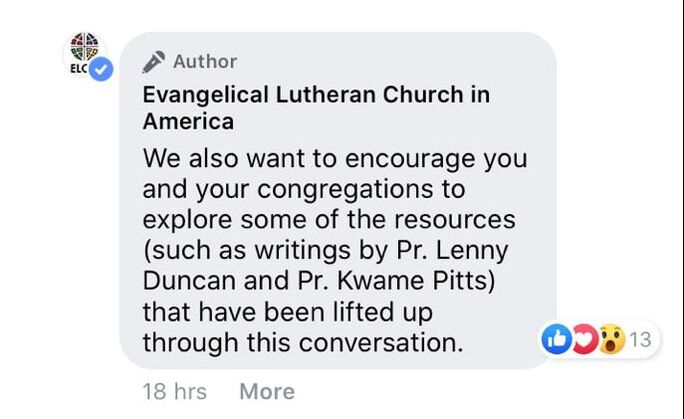
(The following article was written last year by Rev. Tom Brock of pastorsstudy.org. You can follow Pastor Brock on Facebook - here and Twitter - here.) Bishop Herbert Chilstrom was my bishop for years before he became the first presiding bishop of the newly formed Evangelical Lutheran Church in America back in 1988. My heart sank back then when he became head bishop because I knew of his liberal views. He later became a champion for the acceptance of homosexual relationships in the ELCA. And his view won the day in 2009 when the ELCA voted to ordain practicing homosexuals and to allow gay "weddings". Near where I live is an ELCA church where the male Lutheran homosexual pastor has a "husband" who is an United Church of Christ pastor. This is the new world of the ELCA. This month Living Lutheran, the ELCA's national magazine, is presenting a five-part series by Chilstrom on the authority of the Bible. His first article says this: "If the Spirit of God is alive and at work in the church in every age, should we not expect that new insights into our understanding of the Bible will emerge in our own generation—or from the experience of believers in the world?" These words remind me of a conversation I had years ago with a liberal Lutheran pastor on the subject of homosexuality. I pointed out the clear teaching of Romans chapter 1 forbidding homosexual behavior. His response: "The Holy Spirit is leading us to a higher consciousness on this issue than the Apostle Paul had in the First Century." In other words, the Holy Spirit today is contradicting what He inspired the Apostle Paul to write in the First Century. The most liberal Protestant denomination is the United Church of Christ whose motto is: God is still speaking. I'm afraid this means "Yes, God spoke against certain things in the Bible long ago, but God is saying new things to the Church today." This understanding of Scripture allows you to get around any Bible verse that you don't like. And it is tragic, perhaps near blasphemy, to say that the Holy Spirit is the one leading the liberal, mainline Protestant denominations to embrace the world and reinterpret Scripture. The answer to all this, of course, is to remember the Holy Spirit inspired the writing of the Bible and He will not contradict Himself 2000 years later. The Lutheran Reformation was founded upon the Latin phrase "Sola Scripture" which means "the Bible alone" has the final authority. Would that liberal Protestant leaders remember that and not try to imagine a Holy Spirit who contradicts the very book He has inspired. Sincerely in Christ, Pastor Tom Brock 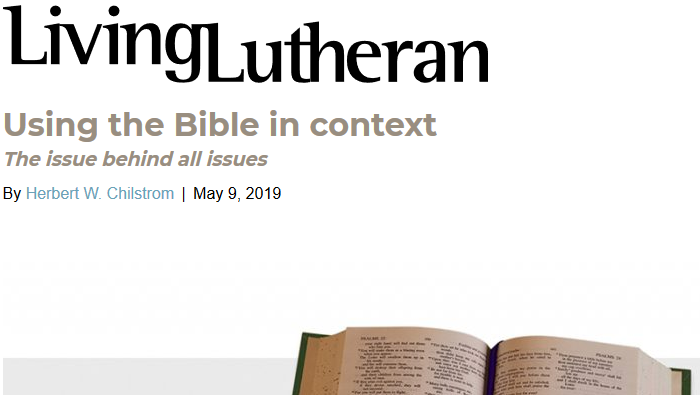 ELCA bishop, Guy Erwin, who is himself gay, recently filmed a video in honor of Pride Month 2019. In the video, Bishop Erwin shares his twisted view of Scripture and the Christian view of homosexuality saying: "...the main purpose of the bible (is) bringing us the message of God's love for all humankind, shown in the life, death and resurrection of Jesus Christ. And we resist efforts to use it as a prop for prejudice and hate." "We oppose all efforts to use our ancient scriptures as a tool to condemn others or separate them from us. We believe God calls us to resist such prejudice, even when it comes from 'religious people' or claims the name of Christianity. And so we support the LGBT+ community as it observes Pride month this month and every month and every June." "My husband and I give thanks to God for the changes that have led us finally to be able to marry." "My church, both nationally and here in Southern California, celebrates its LGBT+ members." "The election of a second gay bishop in the ELCA this summer...is cause for joy for me and the whole church." "I invite you, whoever you are, to join me in thanksgiving to God for the open minds and open hearts that have helped our churches let go of ancient prejudices. To see the grace of God unfolding in new places." "Happy Pride." It seems that the ELCA bishop is saying: - If you hold to the Biblical teaching that homosexuality is wrong/a sin, you hold to "ancient prejudices" and to "hate." - And the national church, the Evangelical Lutheran Church in America, celebrates LGBT+ members. That is similar to saying one celebrates its lying members, drunk members, adulterous members. It is good that all are members, but the church should not be celebrating members' sins and their gatherings aimed at celebrating sin. 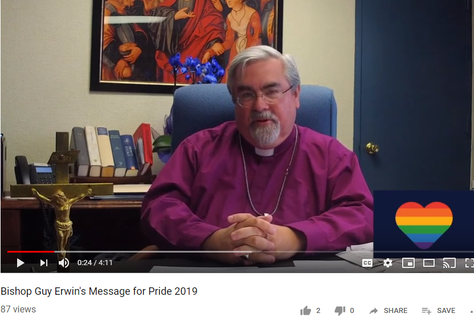 |
Prove all things; hold fast that which is good.
1 Thessalonians 5:21 Dan Skogen
Former ELCA seminary student and former ELCA member who is fed up with the ELCA's consistent mockery of God's Word. If you have been helped and blessed by Exposing the ELCA's ministry, please help us continue to proclaim the truth of God's Word to ELCA members who need to hear it.
Give online by clicking the "donate" button below: Categories
All
Archives
April 2024
 Exposing the ELCA is on Facebook 
Follow Exposing the ELCA on Twitter
Have nothing to do with the fruitless deeds of darkness, but rather expose them. - Ephesians 5:11
|
 RSS Feed